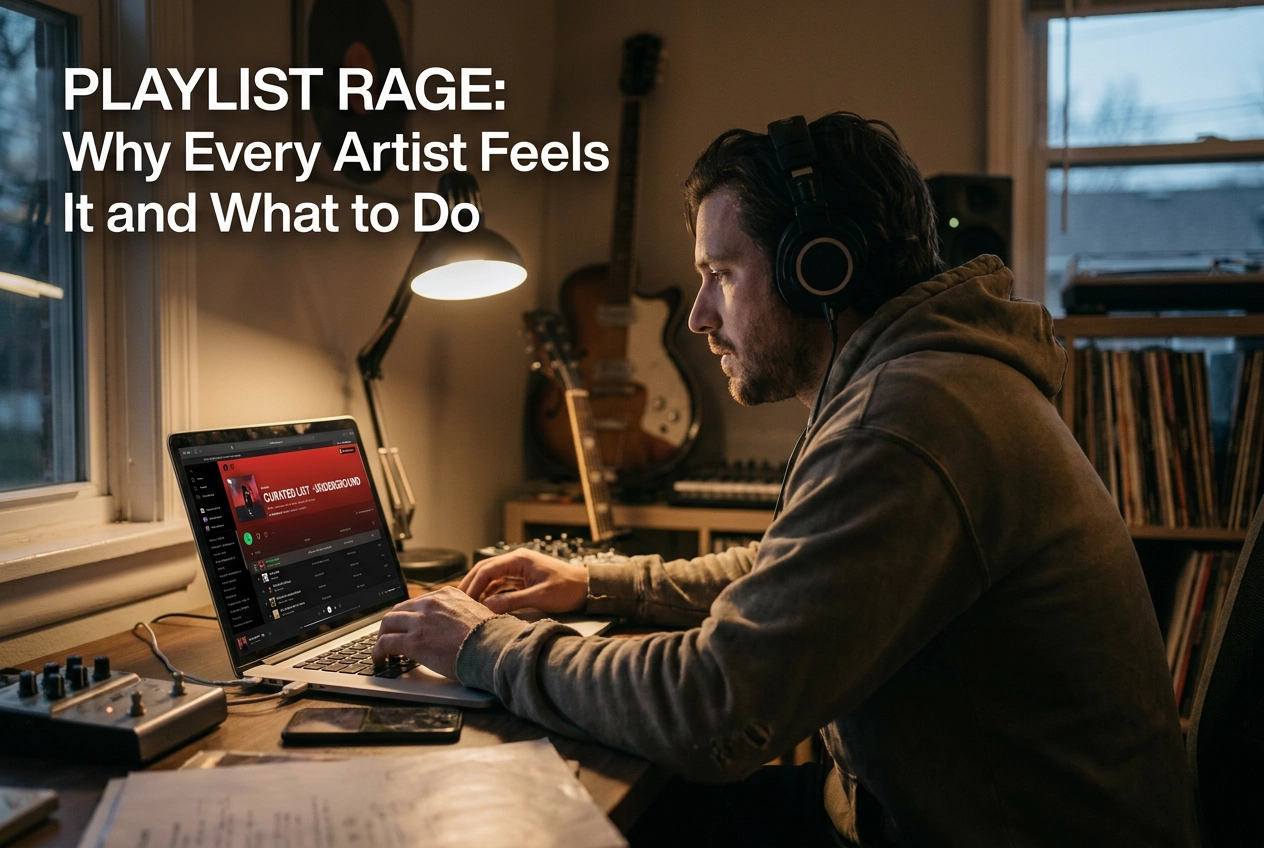
You hit shuffle on your favorite playlist, and suddenly a song you absolutely cannot stand starts blaring through your speakers. Your mood tanks instantly. Sound familiar? That gut-punch feeling even has a name: playlist rage.
Whether you are a music lover, a budding DJ, or just someone who takes their listening experience seriously, playlist rage is something almost everyone deals with. It is that frustrating mix of emotions you feel when a playlist just does not flow right, when a terrible song kills the vibe, or when you have zero control over what plays next.
The good news? You are not alone, and there are real ways to handle it. In this post, we are breaking down exactly why playlist rage happens to every artist and music fan out there, and more importantly, what you can actually do about it. From understanding the psychology behind it to simple, beginner-friendly tips for taking back control of your listening experience, we have got you covered. Get ready to say goodbye to playlist frustration for good.
The Flood Nobody Talks About
Here is something most artists never stop to consider: right now, at this very moment, roughly 1.6 new songs are going live on streaming platforms every single second. That adds up to around 140,000 tracks uploaded every single day in 2026. When your release drops, it does not enter a quiet room where a curator patiently listens through the new arrivals. It enters a relentless flood that never stops moving.
The uncomfortable truth is that most of those tracks will never reach a human pair of ears at all. Algorithms, portal capacity limits, and sheer volume do the filtering long before any curator makes a subjective call about quality. Your song is not being rejected because it is not good enough. In most cases, it is simply not being heard at all, and that is a structural problem with the system, not a verdict on your music.
Curator inboxes reflect this reality directly. When you pitch a playlist and hear nothing back, the silence is almost always a volume problem rather than a dismissal. According to playlist curator databases and directories for independent artists, even the tools built to help artists reach curators warn that many contacts are overwhelmed, abandoned, or mismatched. The infrastructure for pitching has scaled up; human attention has not.
Understanding this reframes everything. Playlist rejection stops feeling personal and starts looking like basic statistics. That shift in perspective is not just emotional relief; it is the starting point for smarter, more targeted strategy.
The Gatekeepers You Cannot See
So where exactly does all that music go once it’s uploaded? A lot of it lands in front of a surprisingly small group of people. Spotify runs a dedicated editorial team of around 150 playlist editors worldwide, each focused on specific genres, moods, and cultural verticals. These editors, including a dedicated Editorial Lead of Global Hits, listen to thousands of submissions every single week. Their job is to decide which artists get placed on flagship playlists like RapCaviar, New Music Friday, and Today’s Top Hits. The catch? Their decisions blend human taste with algorithmic signals, creating a hybrid curation model that neither side can fully explain or predict.
For independent artists, the most painful part is not even the rejection itself. It is the silence that follows. Spotify does not send a reason, a score, or any hint of what went wrong. You pitch your track through Spotify for Artists, wait, and either see results or hear nothing. There is no feedback loop. There is no way to know if your genre tags were off, your momentum was too low, or your pitch just landed in a crowded week. Only roughly 20% of submitted tracks receive editorial placement, yet artists are left to guess why they fell into the other 80%.
Algorithmic playlists like Discover Weekly and Release Radar add another layer of frustration. These playlists do not accept pitches at all. They run entirely on listener behavior data, including saves, completion rates, and repeat plays. Newer artists with smaller audiences are structurally at a disadvantage before a single person ever hears their song. As one industry observer put it, independent curator playlists have become a critical bridge precisely because they generate the behavioral signals that feed the algorithm.
Without any visibility into selection criteria, every rejection starts to feel random rather than fixable. That perception of randomness is where playlist rage really takes root.
The Cheaters Who Broke the System
The playlist system was never perfectly fair, but some people decided to make it a whole lot worse. MIDiA Research flagged the problem as far back as 2019, identifying fake streams, engineered background listening, and coordinated pressure on curators as structural distortions quietly rotting the economics of streaming from the inside. That was six years ago. The problem has not shrunk since; it has compounded, with fraud volume growing roughly 50% year over year through 2023 and 2024 as AI-generated track tools collided with automated bot networks.
The financial motive is obvious once you understand the scale involved. Streaming revenue crossed the 50% mark of all recorded music revenue back in Q1 2019, and by 2023 it represented two thirds of the entire global recorded music economy. When that much money flows through a single channel, bad actors do not need much imagination to figure out where to point their schemes.
Here is what makes it particularly unfair for independent artists: you do not have to buy fake streams to be hurt by them. Spotify itself confirms that artificial streams corrupt the algorithmic data platforms use to surface rising talent. If your track gets added to a playlist that is secretly being botted, your momentum can take a hit even though you did nothing wrong. The algorithm reads inflated numbers around you and recalibrates accordingly.
Then there is the label pressure angle. Major label relationships have long influenced editorial decisions in ways that smaller independent acts simply cannot replicate. Playlist placement starts to feel less like a talent contest and more like a connections game, which is a frustrating reality for anyone without a corporate machine behind them.
The Background Listener Problem
Here is something that might genuinely surprise you. Only about 15% of streaming consumers regularly listen to curated playlists, yet that small group accounts for a wildly disproportionate chunk of total streaming volume. That means playlist placement is both incredibly rare and incredibly powerful at the same time. Landing a spot on the right playlist does not just feel good; it can financially transform an artist’s month.
But here is where things get uncomfortable.
That same playlist ecosystem has a built-in structural bias that quietly works against certain types of artists. A passive listener who hits play on a 60-track lo-fi study playlist and leaves it running for three hours generates far more royalty-eligible streams than a devoted fan who actively searches for your album, listens closely, and replays their favourite tracks. The dedicated fan is more valuable to you emotionally and culturally, but the platform’s royalty math does not see it that way.
Research on background listening from Bridge Ratings reinforces this uncomfortable reality: active engagement and passive consumption are treated almost identically at the royalty level, even though they represent completely different relationships with music.
For artists making lyrically dense hip-hop, emotionally complex folk, or genre-forward experimental music, this stings. The platform infrastructure financially rewards ambient wallpaper over artistry, not because streaming platforms hate good music, but because background-friendly content generates volume at scale. United Musicians and Allied Workers have been pushing back on exactly this kind of structural unfairness, framing it as a systemic labour issue rather than just bad luck for certain artists.
Understanding this dynamic is the first step toward working around it strategically.
Now AI Is Taking Playlist Slots Too
If you thought fake streams and opaque editorial decisions were frustrating, here comes a brand new layer of playlist rage for 2026. Billboard flagged AI-generated and AI-assisted tracks as one of the most pressing questions facing the music industry this year, and the implications for independent artists competing for playlist placement are genuinely alarming. This is not some distant hypothetical. It is happening right now, and it is reshaping the already brutal competition for limited playlist real estate.
The structural problem is this: AI tracks can be produced at virtually zero cost and engineered specifically to match the sonic fingerprints that streaming algorithms reward. The right tempo, the ideal intro length, the exact loudness levels that keep skip rates low. Human artists spend years developing their sound. An AI system can generate a playlist-optimized track in minutes. According to data from Deezer, 44% of all daily uploads are now fully AI-generated, and over 30% of new weekly submissions across platforms are AI-generated or heavily AI-assisted. That is an enormous volume of algorithmically tuned content flooding the same pipelines your music is traveling through.
The royalty questions are just as messy. Fully AI-generated tracks cannot hold copyright under current U.S. law, but revenue can still flow to whoever controls distribution rights. Meanwhile, at the 2026 Grammys, will.i.am noted he attended because it was “one of the last years without robots on the red carpet”, a signal that even mainstream artists feel the clock ticking. For an independent musician who spent three years perfecting an album and submitted a careful playlist pitch, discovering that an AI track landed the slot instead is not just disappointing. It is one of the rawest, most legitimate sources of playlist rage there is in 2026.
Platform-Specific Rage: A Breakdown
Not all playlist rage is created equal, and the platform you’re frustrated with actually determines what your next move should be. Let’s break this down by where you’re hitting walls.
Spotify: Two Different Problems Wearing the Same Face
On Spotify, you need to figure out whether you’re dealing with an editorial problem or an algorithmic one, because they require completely different fixes.
Editorial rejection means a human being, one of around 150 Spotify playlist editors worldwide, heard your pitch and passed. These editors curate the flagship playlists you already know, and their decisions blend gut instinct with data signals. Editorial placements account for roughly 18% of playlist-driven streams, so missing that tier stings, but it is not the whole game.
Algorithmic underperformance is a separate beast entirely. Discover Weekly and Release Radar are driven by listener engagement data. According to analysis of over 2,400 artist campaigns, tracks that consistently land on algorithmic playlists tend to share three traits: a save rate above 20%, a skip rate under 30% in the first 30 seconds, and a stream-to-listener ratio of 2.5 or higher. If those numbers are weak, the algorithm simply does not pick you up, and no amount of pitching changes that.
Apple Music: The Closed Room
Apple Music operates a tightly controlled, curator-driven model with far less public transparency than Spotify. There are no public-facing pitch tools, no dashboard metrics telling you why you were passed over, and no algorithm documentation to study. The path to placement here leans heavily on relationships and industry connections, which makes the whole experience feel like knocking on a door that has no handle on your side.
TikTok: The Unofficial Playlist System
TikTok does not have playlists in the traditional sense, but its sound trend ecosystem functions as a powerful parallel discovery layer. A track catching fire in a specific sound trend can generate stream volumes that rival or exceed a mid-tier Spotify editorial placement. The frustrating part is that the logic behind what goes viral is genuinely unpredictable, driven by community behavior, timing, and creative hooks rather than any formal submission process.
Understanding which platform is actually the source of your frustration matters because the solutions point in completely different directions. Spotify algorithmic issues need audience-building and engagement strategy. Editorial issues need stronger pitch quality and better timing. TikTok needs creative experimentation and genuine community participation. Mixing up the diagnosis means applying the wrong fix entirely.
The Listener Side Nobody Mentions
Most of the playlist rage conversation focuses entirely on artists, but listeners are quietly fuming too, and that frustration matters more than you might think.
Engaged music fans run into a wall that feels almost absurd. You open a playlist with 80 songs expecting variety, and somehow the same 10 to 15 tracks keep circling back around. It happens on editorial playlists especially, where the rotation feels locked in regardless of how large the collection supposedly is. This repetition is not accidental either. Algorithms are built to maximize engagement, and familiar tracks perform more reliably in the short term, so the system keeps serving what already worked rather than taking chances on something fresh.
The deeper problem is the filter bubble effect. Streaming platforms sold listeners on the promise of infinite discovery, a world where you could stumble onto your new favorite artist any given Tuesday. Research into how algorithms shape music taste shows the reality is basically the opposite. Personalized playlists track your listening history and reflect it back at you, gradually narrowing your world rather than expanding it. Experts at Ohio University raised this exact concern in 2026, asking whether streaming now delivers convenient personalization or the death of organic discovery.
Major editorial playlists compound this with homogenization. When commercial considerations and label relationships shape what gets featured, the result sounds less like diverse curation and more like a monoculture on shuffle.
Here is the part that connects directly back to artists. When listeners get bored and disengage, they skip more and listen less. Those degraded engagement signals ripple outward, hurting stream counts for artists across the board. Listener-side playlist rage and artist-side playlist rage are feeding the same problem from opposite ends.
How to Turn Playlist Rage Into a Strategy
All that frustration you have been carrying? It is actually useful information, if you know how to read it.
1. Treat every rejection as a data point, not a verdict.
When a curator passes on your track, the instinct is to take it personally. Resist that. Instead, ask three specific questions: Did you target the right genre playlist, or were you pitching a moody indie folk track to a high-energy workout curator? Did your pitch actually describe the mood, context, and listener moment of your song, or did it just list your credits? Was your release timing deliberate, or did you pitch reactively the day before dropping? A pass from a curator is feedback in disguise. Dig into it.
2. Pitch fewer curators, but pick the right ones.
Mass submitting to hundreds of playlists feels productive, but it almost never works. Relevance signals matter more than volume, both to human curators and to the algorithms watching engagement patterns. Ten well-matched curators who genuinely serve your audience will outperform a hundred misaligned ones every single time.
3. Build the relationship before you pitch.
Engage with a curator’s playlist genuinely first. Comment thoughtfully, share their work, become a recognizable presence in their community. Curators are far more likely to give a careful listen to someone they already recognize than to a cold pitch buried in their inbox.
4. Remove the friction with professional support.
If you do not have the network or bandwidth to build these relationships at scale, that is exactly the problem Playlist Pump was built to solve. Playlist Pump connects independent artists directly with active curators across genres, handling pitch positioning and relationship-building so you can focus on making music.
5. Make pitching a repeatable process, not a one-time gamble.
Track what you send, note what lands, adjust your targeting, and keep going. Consistent outreach with honest tracking and a long-term curator relationship strategy is what separates the artists who break through from the ones still fuming in the inbox.
Playlist Rage Is Rational. Here Is What You Do With It.
Your playlist rage is not a personality flaw or a sign that you need thicker skin. The structural problems are real. Around 140,000 tracks flood streaming platforms every single day, curation decisions happen behind closed doors, manipulation has distorted the economics since at least 2019, AI-generated tracks are now competing for the same limited slots, and passive background listeners generate more royalty-eligible streams than your most devoted fans. You did not imagine any of that.
But here is the honest split you need to make. Some of that system is completely outside your reach. You cannot control editorial opacity, fake stream inflation, or how many AI tracks drop this week. What you can control is your pitch quality, which curators you actually target, when you release relative to your promotional push, and the professional support you choose to invest in.
That frustration you are sitting with? It is a diagnostic signal, not a stop sign. Playlist rage almost always points directly at one specific fixable gap, whether that is a weak bio, mismatched curator targeting, or zero pre-release momentum before your social traffic hits.
Before your next release, pick one concrete action. Rewrite your pitch. Research three curators whose playlists genuinely match your sound and audience. Or explore a professional pitching service like Playlist Pump to access the curator network you simply cannot build alone from scratch. One focused move beats a hundred frustrated ones every time.
Conclusion
Playlist rage is real, it is universal, and it does not have to ruin your listening experience. Here is what to remember: your emotional response to bad playlist flow is completely normal and rooted in genuine psychology. Taking control of your music means curating intentionally, understanding mood and tempo transitions, and building playlists that actually serve your vibe. Small adjustments can make a massive difference in how music feels day to day.
Now it is your turn to take action. Audit your current playlists, remove the songs that consistently kill the mood, and start building with intention. Share your favorite curation tips in the comments below, and pass this post along to every music lover who has ever rage-skipped a terrible song. Your perfect listening experience is not out of reach. It is just one intentional playlist away.