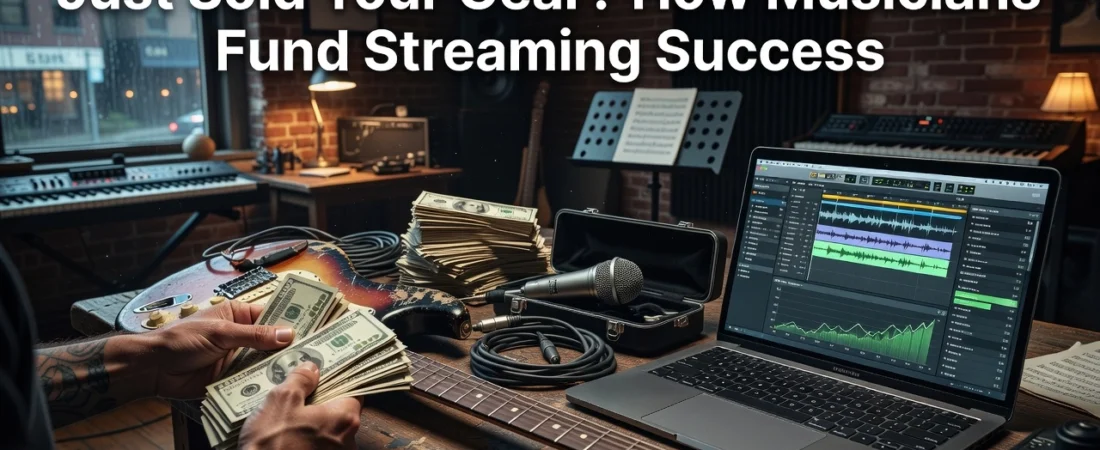
So you just walked out of your local music swop shop with a pocket full of cash from that old guitar you never play anymore. Now what? If you’re like most musicians at the intermediate stage, you’re probably thinking about leveling up your sound and getting your music heard by more people online. But streaming success doesn’t just happen overnight, and it definitely takes more than just uploading tracks and hoping for the best.
The good news is that the money from selling your gear can go a lot further than you think when you spend it strategically. Whether you sold a spare amp, an old effects pedal, or an instrument you’ve outgrown, that cash could be the launchpad your music career actually needs.
In this post, we’re breaking down some of the smartest ways musicians are using gear sale proceeds to fund their streaming growth. From investing in production tools to running smart promotional campaigns, you’ll walk away with a clear list of actionable ideas to make every dollar count. Let’s dig in.
Why Musicians Sell or Swap Gear in the First Place
Let’s be honest: most musicians don’t sell gear just because they need the cash. There’s usually something bigger going on beneath the surface.
The most common triggers are pretty relatable. You’ve upgraded to a better amp and that old combo is just collecting dust. Your studio is starting to look like a music shop, and not in a good way. You’ve got a recording project on the horizon and need to fund it without touching your savings. Or maybe you just don’t feel that spark anymore when you pick up a certain guitar. All of these are completely valid reasons to head to a music swop shop or consignment store and put a piece of kit back into circulation.
And you’re far from alone in doing it. The used instrument market has been on a steady upward climb through 2025 and into 2026, with the vintage guitar segment alone exceeding $620 million in 2025. Musicians are increasingly drawn to used gear for its affordability and the kind of unique character you simply can’t get off a factory floor. Platforms tracking used gear sales show consistent demand, with prices for popular categories stabilising after earlier peaks, creating a healthy environment for both buyers and sellers.
There’s also an emotional dimension here that doesn’t get talked about enough. Selling a beloved piece of gear often signals a genuine career crossroads. Maybe you’re shifting genres, stepping back from live performance, or doubling down on production. Whatever the pivot, the act of letting go is often how musicians make space, both physically and mentally, for what comes next.
That’s what makes this moment so strategically interesting. A gear sale doesn’t just clear clutter; it generates real working capital at the exact moment you’re thinking seriously about your next move. Independent artists operating in a resourceful, DIY career model know how to turn underused assets into fuel for new opportunities, whether that’s recording time, touring costs, or investing in your music’s online presence.
The Hidden Cost of Great Music Nobody Hears
Here’s a reality check that might sting a little: most independent artists will happily drop $1,000 or more on studio time, mixing, and mastering, then spend almost nothing getting that music in front of new ears. It’s one of the most common and costly mistakes in the indie music world, and it quietly kills careers before they get started.
The numbers on Spotify paint a pretty sobering picture. Well over 100 million tracks now live on the platform, with roughly 60,000 new songs uploaded every single day. Studies consistently show that the vast majority of tracks sit below 1,000 total streams, meaning tens of millions of songs are essentially invisible. In 2026, quality alone is not a discovery strategy. A brilliantly produced track with zero promotional push will get buried just as fast as a bedroom demo.
This is what’s often called the promotion gap. Musicians who don’t actively pitch to playlist curators or pursue any kind of outreach simply don’t get found, regardless of how polished their recordings sound. Editorial playlists, algorithmic features, and curator placements drive the bulk of new listener discovery on streaming platforms. Without pitching, you’re essentially releasing music into a void.
Here’s where gear sales become genuinely strategic. Selling unused instruments or equipment through consignment options is one of the few tangible ways to generate a real promotional budget, and most artists let that opportunity slip by without a second thought. Even a few hundred dollars from selling a used guitar or amp through a consignment shop could fund a meaningful playlist pitching campaign.
The mindset shift worth making is this: promotion isn’t an expense you reluctantly tack on at the end. It’s the distribution layer that activates every dollar you already spent creating the music. Without it, your recording investment just sits on a hard drive.
Playlist Pitching: The Highest-Leverage Use of Your Gear Sale Funds
So you’ve sold that unused pedal or traded in the amp collecting dust in the corner. Now you’re sitting on somewhere between $100 and $500, and the big question is: what do you actually do with it?
Here’s the move that most independent artists overlook, and it’s the one with the highest return on investment at this budget level: playlist pitching.
1. You’re reaching listeners who already want to hear you
Playlist placements put your music in front of people who are actively listening to your genre right now. This isn’t cold social media targeting where you’re interrupting someone’s scroll. These are engaged listeners who queued up a playlist because they love exactly the sound you’re making. That warm audience translates directly into higher save rates, longer listen times, and genuine follower growth.
2. One placement can create serious momentum
A single successful add to a mid-tier curated Spotify playlist can realistically deliver thousands of streams, not as a one-time spike but as sustained exposure over weeks. Those streams feed Spotify’s algorithm with valuable data: completion rates, saves, and adds to personal libraries. That data becomes the engine behind Discover Weekly and Release Radar recommendations, creating compounding growth long after the initial placement.
3. Professional pitching is now accessible without a label
This is where Playlist Pump genuinely changes the game for independents. Rather than cold-emailing curators yourself or navigating sketchy promotion services, you get connected to vetted, real curators whose playlists match your genre. No manager required. According to current playlist promotion guides for 2026, organic curator pitching consistently outperforms paid social ads for streaming conversion at comparable budgets.
4. The budget fits what a single gear consignment sale generates
Playlist pitching campaigns typically start around $100 and scale to $500 for more personalized, multi-playlist pushes. That aligns almost exactly with what a used guitar, amp, or effects unit might realistically fetch through a consignment arrangement. You’re not waiting to save up for months; one gear swap can fund a proper campaign immediately.
5. Streams pay you back, ads don’t
This is the critical difference between playlist pitching and most other early-career promotion options. Every stream generates a royalty. The algorithmic data you build improves with every play. Paid social ads stop working the moment your budget runs out, leaving nothing behind. Playlist placements keep working, keep paying small royalties, and keep signaling to Spotify’s algorithm that your music deserves wider reach.
If you’re choosing where to put that first chunk of gear sale money, this is where it compounds.
6 More Practical Ways to Reinvest Your Gear Sale Into Your Music Career
Playlist pitching is the highest-leverage move, but it works even better when your entire music career infrastructure is solid. Here are six more smart ways to put that gear sale money to work.
1. Professional Mixing and Mastering
Streaming platforms are brutally competitive on audio quality, and curators notice immediately when something sounds off. A professionally mastered track hits the loudness targets each platform requires, with Spotify sitting at -14 LUFS and Apple Music at -16 LUFS. Analysis of over two million independent releases found that 79% exceeded Spotify’s recommended loudness levels, meaning their tracks were automatically turned down on playback. Investing in professional mastering fixes tonal balance, translation across devices, and dynamic clarity, giving your track a genuine competitive edge before it ever reaches a curator’s ears.
2. Music Video or Visual Content
Short-form video on TikTok and Instagram Reels has become one of the most powerful organic discovery tools available to independent artists right now. TikTok users are 74% more likely to discover and share new music compared to other platforms, and 56% of independent artists rank it as their top growth platform. You do not need a big production budget here. A smartphone, good lighting, and a consistent posting strategy can drive real streams and algorithmic momentum that feeds directly into playlist consideration.
3. Social Media Advertising
Targeted paid ads let you put a new single in front of hyper-specific listener demographics for as little as $5 to $10 per day. TikTok CPMs currently range from $3.50 to $7, making it one of the most cost-efficient options for independent artists testing new releases. Start small, watch your stream and engagement data, then scale what works.
4. PR and Music Blog Outreach
Press coverage builds the kind of social proof that curators and bookers actually look for. A feature in a respected music blog improves your Google presence, adds credibility to your pitch, and signals that others have already validated your work. Personalized outreach sent three to four weeks before release consistently outperforms last-minute submissions.
5. Recording New Material
A thin catalog limits your pitching opportunities significantly. More quality releases mean more chances to land playlist placements and keep your audience engaged between drops. Consistent output also signals to streaming algorithms that you are an active, developing artist worth promoting.
6. Artist Website and EPK
Before a curator, booker, or journalist engages with you, they will search your name online. A clean website with a professional EPK gives them everything they need in one place, including your bio, music, press clips, and contact details. Investing in your music career outside of gear often comes down to building infrastructure that makes you look like a serious artist worth their time. Combined with strong playlist pitching, a professional online presence closes the loop on every other investment you make.
What a $200 to $500 Gear Sale Can Realistically Achieve for Your Music
Let’s put some real numbers on the table so you can see exactly what’s possible when you reinvest that gear sale money strategically.
A balanced $300 budget breaks down like this: put $150 to $200 toward playlist pitching, allocate $50 to $75 for social media ads targeting genre-specific listeners or similar artist audiences, and keep $50 aside for a one-page EPK or press release. That last piece matters more than most artists expect because a clean, professional one-sheet dramatically improves your acceptance rates when pitching to curators. None of these buckets are wasted, and together they create a promotional ecosystem rather than a single-channel gamble.
On the streaming side, a mid-tier playlist pitching campaign run through a legitimate service can realistically generate 2,000 to 10,000 new streams within 30 to 90 days. The range depends heavily on genre fit, playlist follower quality, and how many placements you land. According to current playlist promotion analysis for independent artists, well-targeted campaigns in genres like lo-fi, pop, or hip-hop consistently hit the higher end of that range when curator matching is tight.
Here’s where it gets interesting. Those streams don’t just sit there counting up. Every save, listen-through, and low skip rate feeds Spotify’s recommendation engine, which can trigger placements in Radio and Discover Weekly organically. Your $300 campaign essentially plants seeds that keep growing after the budget runs out.
The biggest budget mistake artists make is dumping everything into social ads alone. Ads drive temporary spikes; playlists build the catalog discovery signals that algorithms reward long-term.
Finally, think in cycles. Artists running three to four promotion campaigns per year consistently outperform sporadic spenders, regardless of budget size. That $200 to $500 from a gear sale, reinvested every few months, compounds into real momentum.
Gear Swaps Taught You Something Playlists Already Know
There’s a reason the Music Swop Shop in Melbourne has been a fixture for musicians since 1982. It’s not just about cheap gear. It’s about finding the right fit, trading smart, and tapping into a community where mutual benefit drives every transaction. That same philosophy applies directly to how you get your music heard.
Gear swapping and playlist swapping are more alike than most musicians realize. Both are community-driven value-exchange systems where the quality of the match determines the outcome. A mismatched gear swap leaves both parties disappointed. A mismatched playlist placement wastes everyone’s time. When the fit is right, though, both parties walk away better off than before.
Informal playlist swap communities on Reddit (particularly threads in r/musicmarketing) and music forums have existed for years, and they work on exactly this principle. Artists trade placements, share audiences, and build connections organically. The catch is that these communities are largely unvetted. Playlists may have low engagement, inflated follower counts, or audiences that simply don’t match your genre. There are no placement guarantees, no performance tracking, and no accountability when a swap delivers nothing.
This is where professional playlist pitching closes the gap. Rather than guessing whether a curator’s following is real or relevant, professional pitching connects you with vetted curators who have genuinely engaged listeners, genre-matched tastes, and transparent reporting on streams and saves. It’s the difference between a blind trade and a consignment deal with clear terms.
The mindset that drives a smart gear purchase at a music instrument swap community should drive your promotion decisions too. Prioritize value and fit over raw numbers. A playlist with 2,000 engaged listeners in your genre will consistently outperform one with 50,000 passive followers who skip everything.
Community still matters alongside professional services. Genuine participation in playlist exchange spaces builds relationships, earns goodwill, and creates visibility that outlasts any single campaign. The strongest artists in 2026 are combining both approaches, using professional pitching for targeted results while staying active in organic communities for long-term growth.
A Note for Melbourne and Australian Independent Artists
If you’re based in Melbourne or anywhere in Australia, everything we’ve covered in this post applies to you with extra urgency, and here’s why.
Melbourne’s independent music community is one of the most active and resourceful in the Southern Hemisphere. The city has a genuine culture of DIY artistry where musicians handle their own bookings, recordings, social media, and yes, gear trading. That practical, self-sufficient mindset is a real asset, and the Swoppy’s enduring place in Carlton’s music scene is proof that Melbourne musicians have always known how to move resources efficiently. Gear liquidity here is genuinely high, which means funding opportunities are more accessible than artists often realise.
The challenge is that Australian artists face a structural disadvantage on global platforms. Australia has roughly 12.5 million active Spotify users compared to over 115 million in North America. Research examining Australian music in Spotify’s algorithms found a 30% drop between 2021 and 2024 in the number of Australian artists appearing in the country’s top 10,000 streamed artists. Local promotion strategies, no matter how well executed, simply can’t overcome that kind of algorithmic imbalance on their own.
This is exactly where the gear-to-promotion pipeline becomes so practical. Selling a pedal or an amp through a consignment store like Music Swop Shop gives you accessible capital that can be redirected toward international playlist pitching campaigns. Even a modest reinvestment can place your music in front of listeners in the US, UK, and Europe simultaneously, reaching audiences that domestic social media marketing rarely touches. Think globally, fund locally, and let your streaming numbers reflect the full size of the world listening.
Your Gear Sale Is a Career Decision, Not Just a Transaction
Every gear sale is a pivotal moment. You’ve done the hard part, letting go of something you paid real money for, and now you’re holding cash at exactly the moment your motivation to move your career forward is highest. That combination rarely comes around twice, so how you spend it matters.
The single most actionable thing you can take from everything covered in this post: allocate at least half of your gear sale proceeds toward a playlist pitching campaign before anything else gets a cent. Not more plugins, not new strings, not studio time for another track that ends up unheard. Promotion first.
That’s where Playlist Pump connects the dots for independent artists. By matching your music with curators who actually serve your genre and audience, a consignment sale becomes measurable streaming growth rather than just a gear upgrade.
The final mindset shift is simple but powerful: every piece of gear you sell is only truly gone if the money disappears with it. Redirect those funds toward getting your current music heard, and that old amp or pedal becomes the foundation of your next milestone.
Conclusion
Selling your old gear is more than just clearing clutter. It’s a real opportunity to invest in your future as an artist. The smartest musicians are using those proceeds to upgrade their production quality, run targeted promotional campaigns, build their digital presence, and grow a loyal streaming audience one strategic move at a time.
Every dollar you reinvest wisely brings you closer to the kind of momentum that streaming success actually requires. The path forward is clearer than you think when you have a plan.
So take that cash, prioritize the investments that will move the needle most for your music, and start building. Your next step could be as simple as booking studio time or launching your first playlist pitching campaign.
The gear is gone. Now it’s time to let your music do the talking.