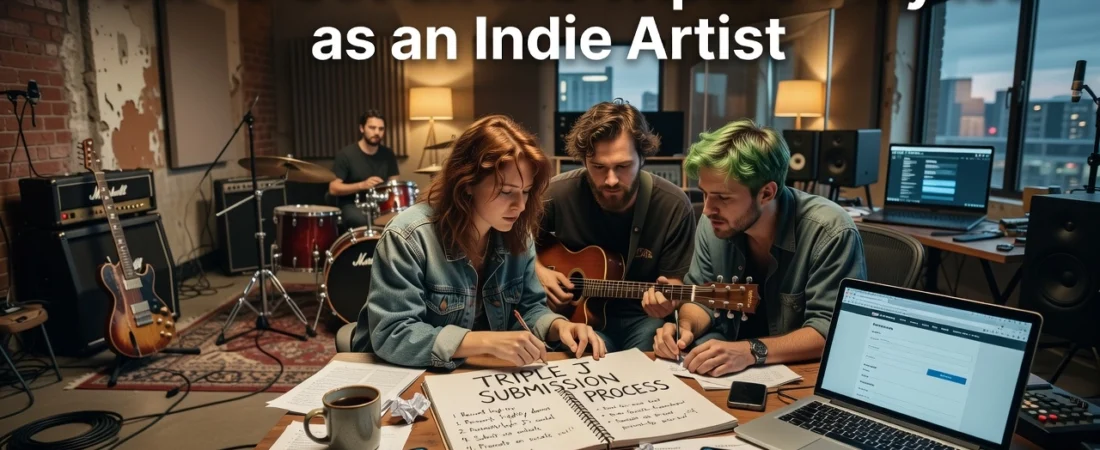
Getting your music on the triple j playlist is one of those goals that feels equal parts exciting and intimidating for indie artists. You know the platform could change everything for your career, but breaking through can seem like cracking a secret code nobody wants to share.
Here’s the thing though: it’s not actually a mystery. Triple j has clear processes, known preferences, and a genuine appetite for discovering fresh Australian talent. The artists landing those coveted spots aren’t just the lucky ones; they’re the prepared ones.
Whether you’ve already submitted to Unearthed a few times without much luck, or you’re just starting to think seriously about your next career move, this guide is going to walk you through exactly what it takes. We’ll cover how triple j discovers new music, what their team actually looks for, how to optimise your Unearthed profile, and the smart strategies that give your tracks a real fighting chance at rotation.
By the end, you’ll have a concrete action plan rather than just wishful thinking. Let’s get into it.
Why the Triple J Playlist Still Matters in 2026
If you’re an Australian artist wondering whether the triple j playlist ecosystem still carries real weight in 2026, the short answer is absolutely yes. Triple j reaches an audience of 3.6 million listeners, and its Spotify New Music Hitlist sits at approximately 295k saves with around 200 rotating tracks updated weekly. That’s not just impressive numbers on paper; it represents a genuinely active, engaged discovery audience that is actively looking for new music to connect with.
The cultural proof is right there in the data. Artists who land in the Hottest 100 experience nearly double the social media follower growth compared to artists who miss out, with that effect being even more pronounced for emerging and indie acts. Olivia Dean’s 2026 Hottest 100 win with “Man I Need” drew 2.1 million votes and dominated headlines across the industry, confirming the poll hasn’t lost a single drop of its cultural authority despite the rise of algorithm-driven streaming platforms.
The radio-to-streaming pipeline is also very real and measurable. Airplay on triple j consistently triggers Spotify and Apple Music playlist additions, follower spikes, and the kind of algorithmic momentum that keeps a track circulating long after the initial feature. The triple j app even lets listeners add tracks directly to their streaming libraries, making the conversion from radio listener to active streamer almost frictionless.
Here’s what separates artists who gain genuine traction from those who upload to Unearthed and then wait indefinitely: understanding that triple j operates as a full ecosystem. Rotation on the main station, specialist show features, Hitlist placement, and strong Hottest 100 performance all work together. Treating any single element in isolation is where most artists stall out.
What ‘The Triple J Playlist’ Actually Means
When most artists say they want to get onto “the triple j playlist,” they’re actually talking about several different things at once, and that confusion costs them real opportunities. Triple j operates across multiple distinct formats, and knowing exactly which one you’re targeting is the difference between a focused strategy and a shot in the dark.
The core formats break down like this. First, there’s the centralized radio rotation, where tracks get slotted into heavy, medium, or light rotation across the broadcast schedule. Then there’s the Spotify ‘New Music Hitlist’, updated weekly with around 200 tracks and sitting at approximately 295k saves, making it one of the most influential discovery playlists in the Australian market. The Apple Music Hitlist runs as a direct companion, featuring songs on heavy rotation and refreshed every week. Finally, program-specific playlists tied to shows like Home and Hosed give artists an entry point that doesn’t require full network-wide rotation.
The Hottest 100 sits in its own category entirely. It’s a listener-voted annual poll rather than a curator-driven playlist, functioning more like a national cultural moment than a standard rotation add. That said, landing in the countdown creates a measurable, lasting streaming lift, with featured artists experiencing nearly double the social media follower growth compared to non-featured acts.
Here’s something worth knowing: radio rotation and the digital playlists are connected but not identical. A track can land on the Spotify Hitlist without heavy airplay, and vice versa. The triple j featured music page also publishes recently played lists, giving you real-time competitive intelligence on what presenters are actually spinning. Monitor these consistently to spot timing patterns before you pitch.
Step 1: Upload to Triple J Unearthed the Right Way
Triple j Unearthed is your primary gateway as an unsigned or emerging Australian artist, and how you approach it makes a genuine difference. The platform allows you to upload between one and three original tracks, which are then open for review by triple j staff, presenters, and the public. Here’s the thing most artists miss: your profile is evaluated before anyone even hits play. Your bio, genre tags, artist photos, and overall presentation act as the first filter, and a half-finished or sparse profile signals to staff that you’re not quite ready for serious consideration.
Prioritise Quality Over Quantity
Resist the urge to fill all three upload slots straight away. Your strongest, most radio-ready track deserves the spotlight on its own. A single standout song has a far better chance of earning a staff review and genuine attention than three works-in-progress competing against each other. Upload your best track first, build some momentum through public engagement, and let that performance inform whether and when you add more. According to the official triple j Unearthed Artist Agreement, only original music where you hold copyright qualifies, so make sure your submission is polished and properly cleared before it goes live.
Nail Your Upload Timing
Timing your submission strategically is something most emerging artists overlook entirely. Aim to upload three to four weeks before your official release date. This window gives presenters enough lead time to genuinely consider the track for airplay while it still carries full “new music” status. Once a song has been widely released and circulating for weeks, it loses that freshness factor that drives playlist and rotation consideration.
Keep an Eye on Unearthed High Cycles
Even if your school days are well behind you, tracking Unearthed High submission windows is a smart move. The competition targets high school acts and runs with periodic submission windows, including activity into mid-2026. These cycles drive significant spikes in staff attention and overall platform engagement, making them useful indicators of when the Unearthed team is most actively listening across the board.
Build a Profile Worth Clicking On
No upload guarantees airplay, full stop. But a complete, professional profile built with links to your Spotify, socials, and an engaging artist story significantly improves your odds of progressing from public discovery to genuine staff consideration. Think of your Unearthed profile the same way you’d think about any professional introduction: first impressions carry real weight in music promotion, and every element you fill in signals that you take your craft seriously.
Step 2: Pitch Triple J Presenters Directly or Via a Publicist
Uploading to Unearthed gets your music into the system, but direct presenter pitching is often where airplay decisions actually get made. Triple j’s presenters aren’t a monolith; each has distinct taste, a specific show format, and an audience they’re curating for. A pitch that references why your track suits a particular presenter’s show will always outperform a generic blast email. Do your research, listen to their shows, and make it obvious you’ve done so. Triple j’s own Tapped In workshops consistently reinforce this point: personalization and conciseness separate the pitches that get listened to from the ones that don’t.
How to Structure a Direct Pitch
Keep your email under 150 words, full stop. Lead with one sentence that explains why this specific track fits triple j’s audience right now, whether that’s a cultural moment, a sonic trend in current rotation, or a thematic hook that resonates with younger Australians. Follow that with a line referencing your Unearthed profile, any streaming numbers worth noting, or recent traction that signals genuine momentum. Include a streaming link (no attachments), proper artist and track labeling, and send it at least two weeks before your release date to allow for premiere consideration. No hype, no gimmicks, just facts presented cleanly.
When a Publicist Is Worth It
If your budget allows, a publicist who specializes in Australian independent music is one of the most reliable ways to compress the gap between release and airplay consideration. Publicists with established triple j relationships can place your track in front of the right person at the right time, bypassing the general Unearthed submission queue entirely. They manage timing around release cycles, handle follow-up professionally, and carry credibility that individual artists simply can’t replicate cold.
Set realistic expectations regardless of your approach. Response times range from a few weeks to complete silence, and rejection is rarely communicated explicitly. Use this window productively by [building parallel promotional momentum](https://www.reddit.com/r/triplej/comments/yi1h3c/whats_the_next_step_after_getting_songs_onto/) across Spotify playlists and social channels, because stronger streaming numbers only strengthen your case if a presenter does circle back.
Step 3: Build Spotify Playlist Traction at the Same Time
Here’s something most artists get wrong: they treat triple j and Spotify as separate campaigns with separate goals. They’re not. They’re two halves of the same engine, and running them in parallel is how you build real momentum.
When your track is accumulating saves, streams, and playlist adds on Spotify, that data tells a story. Triple j presenters and the Unearthed team aren’t just listening in isolation; they’re paying attention to whether a track already has an audience pulling toward it. Streaming traction signals that listeners are responding, which makes your pitch a much easier yes. The loop works in reverse too: triple j airplay consistently drives Spotify saves and streaming lifts, feeding the algorithm and pushing your track into more personalized recommendations.
Target the Right Spotify Playlists from Day One
For Australian artists, the two editorial playlists worth targeting in parallel are Hot Hits Australia and New Music Friday Australia. Both are submitted through Spotify for Artists, and you need to pitch at least seven days before your release date. When you’re filling out the pitch, treat it like a proper brief: include your genre, mood, instrumentation, and a clear sentence about what makes this release timely. Editorial teams are working through large volumes, so specificity helps.
Independent curator playlists are often where artists build their foundation first. They’re faster to land, more accessible for developing artists, and critically, they generate the save data and listener demographics that make your editorial pitch far more compelling when you do submit it.
Why Saves Are Your Most Important Metric
Playlist saves function as a direct signal to Spotify’s algorithm that listeners want to return to your track. A strong save rate strengthens your case for Discover Weekly, Release Radar, and Radio placements, all of which compound your visibility without you having to pitch for them individually. The more genuine saves you accumulate early, the stronger your algorithmic momentum becomes heading into any editorial consideration window.
This is exactly where Playlist Pump comes in. By connecting independent artists with a vetted network of curators across genres, Playlist Pump helps build the kind of Spotify traction that supports algorithmic growth and gives triple j presenters a stronger pitch story to respond to. Real curator placements generate real saves, and real saves build the momentum that makes every other door easier to open.
Step 4: Maximize a Triple J Feature When It Happens
Landing a triple j feature is only half the battle. What you do in the 48 to 72 hours afterward determines whether that moment becomes a career milestone or just a nice story you tell at gigs.
Prepare everything before you pitch, not after you land it. This is the mistake most artists make: they scramble to update their Spotify for Artists profile, pull together press materials, and write a bio that reflects the feature after the fact. By the time you’ve sorted all that, the momentum window has already started closing. Have your press kit updated, your social content drafted, and your Spotify for Artists dashboard monitored and ready to screenshot before you even send a pitch. The feature should be a trigger, not a starting pistol.
Move fast on social proof. The moment a triple j playlist add or presenter shout-out happens, screenshot it and post across Instagram, TikTok, and X within hours, not days. Curator interest compounds quickly when other curators and media see external validation happening in real time. A TikTok showing your track appearing on the triple j New Music Hitlist carries genuine weight with other playlist curators who are actively watching for momentum signals.
If you’re in a Hottest 100 voting cycle, treat it like a full campaign. With the poll drawing a record 3.2 million votes in 2019 and reaching 3.6 million listeners in 2022, even a mid-tier placement delivers a streaming and follower lift that’s genuinely career-defining for independent artists. Activate your mailing list, post regular reminders across socials, and make voting feel easy and urgent for your fanbase.
Pitch Spotify editorial playlists during the lift period, not before it. Algorithmic data is at its strongest right now, and editorial curators prioritize velocity over total numbers. A track climbing quickly is far more compelling than a track sitting at a respectable plateau.
Finally, document everything. Save your Spotify for Artists stats, follower growth figures, saves data, and engagement screenshots from this entire window. That data becomes your case study for every future pitch, whether that’s back to triple j, to festival bookers, or to grant applications.
Triple J vs. Spotify Playlists: The Honest Reality for Indie Artists
Let’s be honest about something most music promotion advice glosses over: triple j and Spotify are not competitors for your attention as an indie artist. They’re genuinely different tools solving different problems, and understanding that difference is what separates artists who build lasting careers from those who chase one platform at the expense of the other.
Triple j carries a kind of cultural credibility that Spotify editorial simply cannot replicate in the Australian market. When a presenter drops your track into rotation or your song cracks the Hottest 100, that moment functions as a press quote, a career milestone, and a streaming catalyst all at once. It signals to bookers, labels, journalists, and fans that someone with taste and cultural authority has vouched for your music. That validation has a long shelf life in the Australian industry in a way that a Spotify playlist add, however valuable, typically does not.
Spotify, on the other hand, wins on raw scale and speed. Editorial and algorithmic playlists can push your streams into the tens of thousands within days, particularly for genres with strong international playlist ecosystems. If your sound skews toward pop, electronic, or indie with global appeal, Spotify’s recommendation engine can open doors to audiences that triple j’s Australian-focused programming was never designed to reach.
The international competition angle is worth taking seriously too. A 2025 report found that fewer than one-third of Hottest 100 songs were by Australian artists, the lowest local representation since 1996. That tells you the benchmark is genuinely tough, and relying solely on a triple j pathway without building parallel Spotify momentum leaves real exposure on the table.
Radio listenership among triple j’s core 18 to 24-year-old audience has also shifted significantly, with streaming sitting at 94% weekly usage compared to roughly 41% for traditional radio in that demographic. Triple j’s cultural pull remains strong, but its ability to convert listeners into streams is now heavily tied to those linked digital playlist adds on Spotify and Apple Music.
The smartest independent artist strategy in 2026 is triple j and Spotify, running simultaneously. A triple j feature boosts your algorithmic credibility on streaming platforms. Strong Spotify numbers make your pitch to triple j presenters look more compelling. Each channel reinforces the other, and at Playlist Pump, we consistently see that artists who treat both as a unified campaign outperform those who pursue them separately.
Where Playlist Pump Fits Into Your Triple J Strategy
Playlist Pump specializes in connecting independent artists with vetted Spotify playlist curators, and for Australian artists navigating the triple j ecosystem, that’s a genuinely useful piece of the puzzle. The streaming traction you build through curator placements, including real saves, retention rates above 40%, and growing monthly listener numbers, becomes tangible evidence of audience demand. That kind of data makes your triple j pitch more credible, not just more impressive on paper.
The practical value here is timing. The Unearthed review process and direct presenter pitching can stretch across weeks with no guaranteed outcome. While you’re waiting, a Playlist Pump campaign runs in parallel, feeding Spotify’s algorithm with the engagement signals it needs to push your track into Discover Weekly and Radio feeds. You’re not stalling; you’re compounding.
Curator placements that generate genuine streaming velocity, think 7,000 to 20,000 streams with strong listener retention, produce the kind of data that both triple j presenters and Spotify editorial teams notice when they’re evaluating whether a track has real traction behind it. It shifts you from “emerging artist with a decent upload” to “artist with a documented audience.”
For Australian independent artists, this approach removes the anxiety of depending on a single gatekeeper. Your promotional momentum keeps moving regardless of triple j’s timeline or response.
The bigger picture is a compounding effect: Playlist Pump builds your Spotify foundation, triple j adds Australian cultural credibility and tastemaker validation, and together they shape an artist profile that attracts press coverage, sync licensing interest, and touring opportunities. Neither channel works as well alone as they do together.
Your Next Steps Toward Getting on Triple J Playlists
The four-step system really does work as a complete unit: optimize your Unearthed profile, pitch presenters strategically, build Spotify traction simultaneously, and maximize every feature that lands. Each step feeds the next, and skipping one weakens the whole chain.
The biggest mindset shift worth repeating is this: triple j is a powerful accelerator, not the finish line. Artists who treat it as one important channel within a broader multi-platform strategy consistently outperform those chasing it exclusively. Radio prestige is real, but sustainable momentum comes from stacking Spotify growth, social engagement, and live presence alongside it.
Start today with what you can actually control. Polish your Unearthed profile, plan your release timing carefully, and begin your Spotify curator outreach now rather than waiting for a triple j breakthrough to validate the effort.
For that Spotify side of your strategy, Playlist Pump’s curator network is built exactly for this moment, connecting independent artists with real curators who move the needle on streams while you pursue the longer-term triple j goal.
Conclusion
Getting on the triple j playlist is absolutely within your reach as an indie artist. To recap the essentials: optimise your Unearthed profile with professional presentation and complete metadata, submit music that aligns with triple j’s sonic identity while staying true to your sound, build genuine engagement with the Unearthed community, and be consistent rather than treating it as a one-shot opportunity.
The artists who break through are not the most connected or the most polished. They are the most prepared and the most persistent.
Now it is time to put this into action. Log into your Unearthed profile today, audit what needs improving, and get your next track submission ready. Every play, comment, and connection builds momentum.
Your breakthrough playlist moment starts with a single intentional step. Go take it.