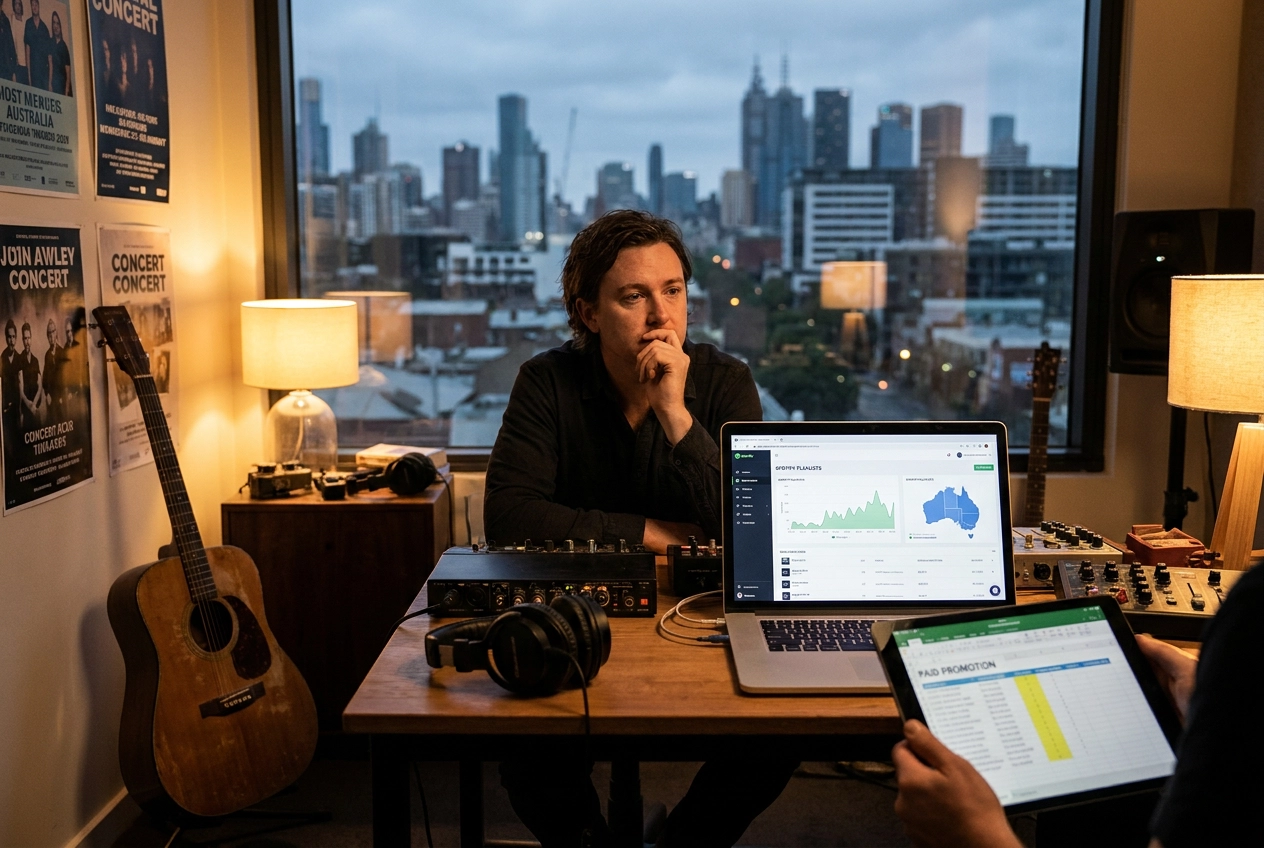
Spend five minutes researching playlist promotion services and you will find no shortage of bold claims: thousands of streams guaranteed, placements on high-follower playlists, and exposure that will supposedly transform your career. For Australian indie artists navigating Spotify for Artists data and trying to stretch a limited promotional budget, those promises can be genuinely tempting. The problem is that most services are selling reach while quietly glossing over the metrics that actually determine whether your money was well spent.
This analysis cuts through the noise. You will find a frank breakdown of what playlist promotion services actually deliver, how to run the numbers before you commit to any spend, and why raw placement counts tell you almost nothing useful. From understanding why follower counts are a misleading benchmark to identifying the genre-fit factors most artists overlook entirely, this post gives you a practical evaluation framework built around the realities of the Australian market. Whether you are considering your first campaign or reassessing a service that has already underdelivered, the goal here is simple: help you make an informed decision based on evidence, not marketing copy.
The Promise vs. the Reality of Playlist Promotion
Most music promotion services lead with two headline numbers: placements secured and playlist follower reach. Neither tells you whether a single real listener pressed play, stayed past the thirty-second mark, or saved your track to come back later.
That gap, between a placement on paper and a listener who actually engages, is where most promotion budgets disappear quietly.
The distinction matters because saves, repeat plays, and artist follows are the behaviours that signal genuine interest to Spotify’s algorithm. A passive stream from a distracted playlist scroll does almost nothing for your long-term visibility. Promotion services that report placement counts without retention data are, in effect, hiding the only numbers that would let you judge whether the campaign worked.
Australian indie artists face a compounded version of this problem. Unlike artists in the US or UK, who can cross-reference their results against a dense pool of local benchmarks, Australian artists have limited comparison data. When a service reports 8,000 streams from a campaign, there is no reliable local baseline to tell you whether that is genuinely strong or simply average dressed up as a win.
There is growing pressure from artists and managers to move beyond placement counts toward retention-based reporting. Yet many promotion services have not updated their reporting frameworks to reflect this shift. They still lead with placements and follower totals because those numbers are large and easy to sell.
Understanding that mismatch is the first analytical move before evaluating any provider. Knowing how to use replay data and listening behaviour to assess real engagement gives you a sharper lens before you spend a cent.
The sections that follow break down exactly which metrics move the needle and how to run the numbers before committing budget.
What Metrics Actually Move for Streaming Growth
So you know the gap exists between a placement and a result. The next question is which numbers actually close it.
Stream count is the most visible metric, and the least trustworthy. It is manipulable, it does not indicate whether anyone listened past the first ten seconds, and on its own it tells you nothing about whether a listener will ever interact with your music again. Treat streams as a starting point, not a scorecard.
Listener retention rate (the share of a track listeners play through before skipping) is a stronger signal. Spotify’s algorithm weighs engagement quality, and a high skip rate on a playlist placement signals the opposite of success. A promotion service cannot control whether listeners skip, but the genre-fit of its placements directly determines whether they do. Before you read anything else about a campaign, check whether your track fundamentals are solid first, because a poorly optimised release will bleed retention regardless of placement quality.
Repeat play rate indicates whether listeners saved and returned to a track. A single passive scroll-past on a playlist generates a stream; a listener who replays the track is a follower conversion candidate. These are not the same outcome, and only one compounds.
Playlist saves are the clearest intent signal available in your Spotify for Artists analytics. When a listener saves your track to their own library or playlist, they have made an active choice. A credible promotion service should be able to report saves as a campaign metric, not just aggregate stream totals.
Follower conversion rate is where campaigns either justify their cost or quietly fail. High streams with low follower conversion means listeners heard the track and moved on. That is a genre-fit or quality problem, not a volume problem. More placements will not fix it.
Finally, use the source-of-streams data in Spotify for Artists to verify that playlist placements actually drove activity during your campaign window. If the stream source data does not shift when your placement goes live, you have your answer.
Running the Break-Even Math Before You Spend Anything
Knowing which metrics matter is only useful if you’ve already decided the spend is justified. That calculation starts with one uncomfortable number.
Spotify’s per-stream payout sits at roughly $0.003 to $0.004, derived from aggregate industry payout data rather than a published rate card. Run that against any promotion package and the break-even threshold in royalties alone is very high — most playlist campaigns for independent artists do not get close to it.
That is not a reason to avoid promotion. It is a reason to stop evaluating it as a royalty recovery exercise.
The real ROI question is what non-royalty outcomes the campaign produces, and that is covered in detail below. Follower growth, algorithmic pickup via Discover Weekly or Radio, and increased visibility for sync or live booking enquiries are where the actual return lives.
The Cost-Per-Stream Calculation
Using Spotify for Artists source-of-streams data, divide total campaign spend by streams attributable to the campaign window. Use your own campaign spend divided by attributed streams as a personal benchmark; compare across campaigns rather than against an industry-published rate.
Tier the analysis by what each metric actually signals. Streams are a lagging indicator; they reflect what already happened. Saves and follows are leading indicators, showing sustained listener intent. Algorithmic playlist additions are the highest-value downstream outcome a placement can unlock, because they extend reach without additional spend.
Australian artists purchasing services priced in USD carry an additional cost layer from currency conversion. Always convert to AUD before comparing packages and recalculate your break-even threshold accordingly.
Before committing budget, run through four questions: What is the total AUD-adjusted spend? What stream count does the service project? What is the implied cost-per-stream? What non-stream outcomes does the service guarantee or track? If a service cannot answer the last question clearly, consider booking an A&R consultation to establish realistic benchmarks before spending anything.
Why Playlist Follower Counts Are a Misleading Benchmark
Even if your break-even math looks reasonable on paper, it can collapse entirely if the playlist driving those projected streams is far less active than its follower count suggests.
A playlist showing 50,000 followers reflects historical opt-ins, not current listening behaviour. Many users follow a playlist once and never open it again. The follower figure tells you how many people thought this playlist was worth bookmarking at some point; it tells you nothing about how many people will actually hear your track this week.
Engagement rate is the figure that matters. Calculated as active listeners divided by total followers, it reveals what proportion of a playlist’s audience is genuinely engaged. A playlist with 50,000 followers and 1,500 monthly active listeners has a 3% engagement rate; one with 8,000 followers and 2,400 active listeners is performing at 30%. The smaller playlist is the stronger placement.
Curator activity is a secondary health signal. Check when the playlist was last updated, how regularly tracks are added or removed, and whether it appears in organic Spotify search results. A dormant playlist, unchanged for months and invisible in search, is not a living editorial product; it is an archive with a misleadingly large number attached to it.
Bot-inflated playlists present a more serious risk than wasted spend. Spotify’s own guidelines confirm that artificial streams are removed through fraud detection, with consequences including royalty withholding, song removal, and account suspension. Placement on an inflated playlist does not just fail to help; it can actively damage your artist account.
Before committing any budget, ask the service directly for engagement rate data on the specific playlists being proposed. If that request is deflected or met with follower totals instead, treat it as a hard no. Playlist Pump’s curator vetting centres on active listener behaviour and curator engagement history rather than raw follower numbers; it is worth comparing that standard against what other services actually provide.
Genre-Fit Alignment: The Factor Most Artists Underestimate
Follower count and engagement quality tell part of the story. The other part is whether your track actually belongs in the playlist at all.
A placement in a high-follower playlist that mismatches your genre context will drive high skip rates, and Spotify’s algorithm reads every early skip as a negative signal. Skip rates in concerning territory are associated with suppression of Radio placements, Autoplay recommendations, and Discover Weekly inclusion. A campaign that generates skips at scale is not neutral; it is actively working against your algorithmic visibility.
Genre-fit goes deeper than the obvious label match. Tempo, production texture, mood, and the demographic profile of regular playlist listeners all determine whether your track sounds like the natural next song or an interruption. A polished indie-pop track dropped into a lo-fi study playlist may share a genre family, yet the energy mismatch will produce skips that register as underperformance regardless of how strong the track is.
Australian artists face a compounding version of this problem. Many international promotion services carry limited inventory of locally relevant playlists, so pitches default to generic global lists where Australian listener affinity tends to be low. Listeners in those playlists are not your audience, and the skip data that accumulates reflects that mismatch, not the quality of your music.
The practical fix is simple: request the specific playlists before you commit. Listen to three or four tracks in each one. If your song does not sound like a natural follow-on, it does not belong there, regardless of the follower count attached to it.
Services that treat genre-fit as a defined matching process rather than a tick-box tend to produce meaningfully better listener retention outcomes than those operating on volume-first placement logic. When evaluating any music promotion service, ask directly how genre matching is determined and whether that process accounts for tempo, mood, and listener demographic, not just the playlist’s category tag. Vague answers here are a reliable signal that placements are built around availability rather than fit.
The Australian Market Gap and What It Means for Your Campaign
Genre-fit solves one layer of the problem. But even a perfectly matched placement can underperform if the service delivering it has no real understanding of the Australian market.
Australian indie artists work with fewer local streaming benchmarks than their counterparts in the US or UK. Without reliable regional data, it becomes genuinely difficult to judge whether a promotion service’s results are strong or simply average against a low baseline. A campaign that looks successful in isolation may be unremarkable once measured against what engaged local placements actually produce.
The listener behaviour gap compounds this. Australian listeners may have different playlist consumption habits and genre affinities than global averages suggest — a risk that generic international campaigns do not account for. An international placement reaching predominantly Northern Hemisphere audiences during their prime listening hours may barely register with the Australian listeners who are most likely to save your track, follow your profile, and show up to your shows.
Supply scarcity is a real structural issue as well. Finding high-quality, genre-specific Australian playlists with genuinely engaged local followings requires effort; a service that cannot name its local curator relationships likely has few. Competition for those placements is correspondingly high, and placement fees often reflect that scarcity. A service offering cheap, high-volume placements almost certainly is not sourcing from this pool.
This is where a practical due diligence question matters: ask any service you evaluate for Australian-specific placement data, not just global reach figures. Which local curators are in their network? What regional listener data do they hold for those playlists? A service that cannot answer these questions clearly is applying a generic international template to your campaign, regardless of what their pitch deck says.
The strongest campaigns tend to combine Australian curator relationships with targeted international placements. Local listeners convert at higher rates because the affinity is already there; they are more likely to save, follow, and engage beyond a single passive stream. Spotify has operated in Australia since 2012, and the local ecosystem has matured enough that services without genuine local curator connections are leaving meaningful growth on the table.
Red Flags That Tell You to Walk Away
The same gaps that make the Australian market tricky to navigate also make it easier for low-quality services to hide behind vague results. Here are the patterns that should end the conversation before you hand over any money.
Guaranteed stream counts. No legitimate placement can guarantee listener behaviour. Streams follow from real people choosing to listen, and no curator controls that. Any service promising a specific stream number without explaining the mechanism behind it is either working with bot traffic or making a commitment it cannot keep.
Reporting that stops at total streams and follower reach. If a post-campaign report does not break down listener retention, skip rates, or saves, the service is withholding the data that would let you judge whether the campaign actually worked. That omission is a choice, not an oversight.
Refusal to name the playlists before you pay. Any credible music promotion service can show you exactly which playlists your track will be submitted to. Vague references to a “curator network” without specifics is a transparency failure. You should be able to listen to those playlists yourself before committing budget.
Suspiciously low cost-per-stream pricing. If the implied stream volume is vastly out of proportion to the price, the streams are almost certainly artificial. Artificial stream inflation violates Spotify’s Terms of Service and the risk of stream removal and account flagging falls entirely on you.
No post-campaign reporting structure. If a service has no follow-up process, no guidance on reading your Spotify for Artists data, and no way for you to independently verify results, it is not built around accountability. Legitimate services expect you to check.
Language that cannot be converted into a number. “Boost your visibility” and “increase your reach” are non-answers dressed as promises. Every commitment a service makes should map to a specific, verifiable metric. If it cannot be measured, it should not be trusted.
What a Quality Playlist Promotion Service Actually Delivers

Knowing what to avoid gets you halfway there. Understanding what a quality service actually provides closes the gap.
A credible promotion service discloses the specific playlists being targeted before you commit, not after. That means named playlists, curator activity history, listener demographic data, and engagement rates, not a follower count presented as proof of reach. If a service cannot show you where your track is going, you have no basis for evaluating whether the placement is worth anything.
Genre-fit matching should be a structured intake process. A quality service asks about your track’s tempo, mood, production style, and target listener profile before recommending any placements. This is not a checkbox; it is the mechanism that determines whether listeners actually engage or skip within the first ten seconds.
Post-campaign reporting needs to be cross-referenceable. Placement dates should align with observable shifts in your Spotify for Artists data, specifically in source-of-streams breakdowns, save rates, and listener behaviour during the campaign window. Tracks generating strong save rates from playlist sources are precisely the ones positioned to benefit from downstream algorithmic pickup — the kind of signal good reporting should help you identify.
As the break-even section establishes, the real case for promotion rests on algorithmic pickup and follower growth rather than royalty recovery. A service that articulates this clearly is one you can trust to set realistic expectations.
At Playlist Pump, curator relationships are built around listener engagement quality rather than follower volume. That distinction is what separates placements that produce measurable metric movement from placements that produce nothing but a line on a report.
One further marker of a quality service: it will tell you when your track is not ready. Incomplete metadata, an unclaimed Spotify for Artists profile, or a missing Release Radar setup will undermine a campaign before it starts. A service that flags this rather than takes your money anyway is demonstrating exactly the kind of accountability worth paying for.
Realistic Timeline Expectations for Measurable Growth
Even with a well-executed, genre-matched placement, results do not appear all at once. Understanding the sequence matters as much as knowing the metrics.
Stream data begins appearing within the first week of a placement going live, but meaningful engagement signals — saves, follows, and repeat plays — take several weeks of active placement to accumulate reliably. Algorithmic downstream effects such as Discover Weekly and Radio inclusions materialise later still, and only when genuine engagement thresholds are met. Allow at least four to six weeks before drawing conclusions, and measure via your Spotify for Artists source-of-streams data.
This sequencing explains one of the most common mistakes artists make: checking results at the one-week mark, seeing modest numbers, and writing off the campaign. That is a timing error, not an accurate evaluation.
Follower growth follows a similarly gradual curve. Steady accumulation is preferable to spikes, which are often synthetic and do not compound the way genuine listener-driven growth does.
One final timing consideration: repeat campaigns on the same track yield diminishing returns. Listener fatigue in playlist contexts is real, and Spotify’s algorithm weights recent engagement more heavily than accumulated historical streams. Once a track has run its campaign cycle, the more productive move is directing budget toward a new single rather than re-promoting the same release.
Building Your Own Evaluation Framework Before You Buy
Knowing your evaluation window matters, but it only helps if you enter a campaign with the right framework to interpret what you see.
Start by defining your primary goal. Algorithmic pickup, follower growth, save rate, and industry visibility each require different campaign structures and different success criteria. A campaign optimised for Discover Weekly pickup needs strong listener retention signals. A campaign aimed at follower growth needs genre-matched placements with high artist-click rates. Conflating these goals produces campaigns that underdeliver on everything.
Before you contact any service, run through this checklist:
- Specific playlists disclosed upfront (not “our network”)
- Engagement rate data provided for those playlists, not just follower counts
- Genre-fit process clearly explained
- Post-campaign reporting included as standard
- Bot-risk mitigation methodology described
- Cost-per-stream calculated in AUD, accounting for the exchange rate if the service prices in USD
If any item is missing, that is not a minor gap; it is a structural transparency failure.
Set your Spotify for Artists baseline before the campaign launches. Log your current streams, listener count, save rate, and source-of-streams data. Without this pre-campaign snapshot, any post-campaign movement is unattributable. You cannot separate the promotion’s effect from organic growth if you have no starting point.
Your budget ceiling should come from your own break-even analysis, not from the service’s pricing tiers — with the minimum non-royalty outcomes (follower adds, saves, algorithmic pickups) that justify the spend acting as the filter.
Finally, ask every service the same three questions: What specific playlists will my track be submitted to? What engagement rate data do you have for those playlists? How do you report results post-campaign? Services that cannot answer all three clearly do not deserve your budget.
What Australian Artists Should Take Away
The principles covered above reduce to a short list worth keeping.
Genre-fit alignment and curator engagement quality are the two variables most predictive of results. A placement in a high-follower, misaligned playlist produces skip data that works against you algorithmically. Demand specific playlist details and real engagement figures before paying, not after.
Playlist Pump is built around exactly these standards: curator relationships selected for active listener engagement and genre relevance, transparent pre-campaign playlist disclosure, and post-campaign reporting designed to cross-reference against your own Spotify for Artists data. For Australian indie artists who are done paying for reach that does not convert, that kind of accountable, genre-matched approach is where measurable growth actually starts.
Conclusion
Playlist promotion can move the needle for Australian indie artists, but only when approached with clear eyes and the right criteria.
The artists who see real results treat promotion as a strategic investment with measurable benchmarks, not a shortcut to overnight numbers.
Ready to invest in promotion that holds itself accountable? Audit your next campaign before it starts. Define your success metrics, demand transparency upfront, and choose a service — like Playlist Pump — that reports back with data you can verify yourself.