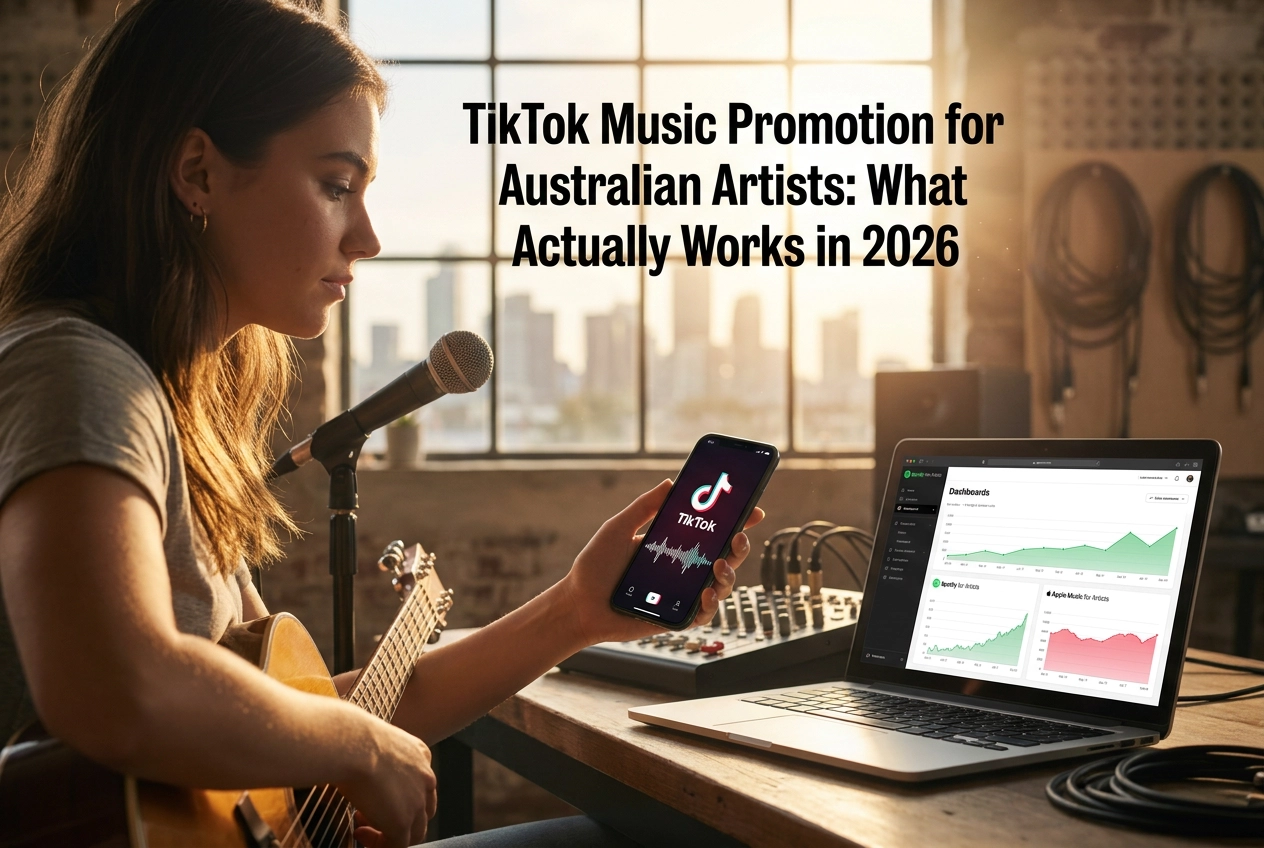
You’ve seen it happen. An Australian artist drops a TikTok clip, it racks up half a million views overnight, and then… three weeks later, their monthly listeners are basically back where they started. The viral moment came and went, and the algorithm moved on without them.
Here’s the thing: TikTok is one of the most powerful music discovery engines on the planet right now, but discovery alone doesn’t pay. Turning that attention into real, lasting growth on Spotify and Apple Music for Artists is where most indie musicians get stuck, and it’s exactly what this playbook is designed to fix.
In this post, you’ll learn how to build a TikTok presence that actually signals streaming intent, how to read your analytics before you pitch a single playlist curator, and how to convert momentum into placements that keep your numbers climbing long after the original video stops trending. Whether you’re chasing your first editorial placement or trying to stop the post-viral slump, this guide covers the full picture, from your first TikTok hook to a repeatable promotion workflow that compounds over time.
Why TikTok Alone Is Not a Music Career Strategy

Getting a million views on TikTok feels like a breakthrough. Then you check Spotify for Artists three days later and your monthly listeners have barely moved. Sound familiar?
Here’s the problem: TikTok is a discovery engine, not a streaming platform. Views don’t generate royalties. A For You Page appearance doesn’t signal the Spotify algorithm to recommend your track. The streams, the saves, the royalty income, and the algorithmic permanence that actually builds a career, all of that lives on Spotify and Apple Music, not on TikTok.
The spike-and-crash is the norm, not the exception. A TikTok video gains traction, listeners search your track, streams jump briefly, then the algorithm sees a blip rather than a trend and your monthly listener count resets to baseline. Spotify’s own conversion research shows that listeners who save a track or add it to a playlist are 1.4x more likely to still be listening a month later. A passive stream spike, driven by TikTok curiosity, produces almost none of those save behaviours on its own.
What separates artists who convert viral moments into lasting growth is not luck, and it’s not posting volume. It’s having a deliberate off-platform conversion strategy ready to activate the moment a post gains traction. That means playlist pitching, direct listener engagement, and treating TikTok data as the trigger for action elsewhere. Platforms like Spotify for Artists and Apple Music for Artists give you the dashboards to see whether that conversion is actually happening.
For Australian artists, the stakes are higher. The domestic market is smaller than the US or UK, so a local viral moment carries less raw stream volume than an equivalent spike overseas. Conversion efficiency matters more here, not less. You cannot afford to let traction evaporate.
Think of it this way: TikTok is the ignition. Playlist placement is the engine. Building towards driving virality across platforms is how that engine compounds. The rest of this playbook shows you exactly how to connect all three.
Build Your TikTok Foundation for Music Discovery
Before any of that strategy pays off, your TikTok profile needs to be set up correctly. Most Australian indie artists skip the technical groundwork and wonder why their viral moments don’t stick.
Step 1: Switch to a Creator Account and link your distributor profile
A standard personal account won’t cut it. A TikTok Creator Account, once certified through TikTok Studio’s Artist Hub, unlocks the Music Tab, which displays all your official sounds in one place and connects them to streaming platforms. You’ll need at least three tracks delivered through your distributor to qualify. Once live, your song becomes a proper clickable sound, not just borrowed audio, which is what feeds TikTok’s music graph.
Step 2: Use geo-targeting from your very first posts
Tagging Sydney, Melbourne, or Brisbane in early content may help build a regional Australian audience before the algorithm distributes your sound more widely, start local before going broad. Building traction with Australian viewers before the algorithm pushes your sound wider gives you a credible regional fanbase rather than scattered global views that don’t convert. Think of it as earning your local audience before earning everyone else.
Step 3: Optimise your profile
Run through this quickly:
- Bio link: Point to a smart link that routes to Spotify, Apple Music, and other platforms simultaneously, not just one DSP
- Visual identity: Consistent profile photo, colour palette, and thumbnail style across posts signals a professional presence
- Pinned post: Pin the video using your best-performing sound, so new profile visitors immediately hear your music
Step 4: Post during Australian prime windows
Ignore US-centric advice. The 7pm to 10pm evening window is widely cited among Australian creators as a higher-engagement window, test it against your own audience insights and adjust. Your Australian followers are scrolling after dinner, not at 9am Pacific time.
Step 5: Understand what the algorithm actually measures
Raw likes matter less than you think for music content. The signals most commonly cited as high-priority by TikTok creators and social analytics platforms include completion rate, sound saves, and duet or stitch engagement. Understanding this distinction matters just as much as knowing what Amazon Music curators actually want in a pitch when you move into the distribution phase.
TikTok Content Tactics That Drive Streaming Intent
With your foundation in place, the next job is making content that does more than rack up views, it needs to push people to hit play on Spotify or Apple Music.
Start with the emotional peak, not the build-up. TikTok viewers decide whether to keep watching within the first two seconds. If your track has a spine-tingling chorus or a lyric that hits hard, that’s your opener. Drop viewers straight into it. Completion rate tends to suffer when the emotional payoff is delayed, and completion rate is one of the signals TikTok uses to decide who else sees your post.
Four formats consistently convert for Australian artists:
- Behind-the-lyrics storytelling. A 15-second clip explaining the real moment that inspired a lyric creates emotional investment that drives listeners to find the full song.
- Studio process clips. Raw, unpolished footage of a track coming together performs well precisely because it feels unfinished, curiosity pulls viewers to the release.
- Location-specific content. Shooting at the coast north of Sydney, in the bush, or against Melbourne’s laneways signals Australian identity visually. That specificity builds a regional audience who feel the music belongs to their world.
- CTA posts timed to pitching campaigns. When you’re actively pitching playlists, publish a direct post (“this track is out now, add it to your library”) while the momentum is live. You can also focus on sharpening your pitch narrative with listener data when you move into outreach.
Always use your own track as the native sound, rather than trending audio that sends save activity to someone else’s catalogue. When your track is the sound, each save feeds TikTok’s music graph and signals genuine listener intent.
Brief your community for UGC. A simple caption like “use this sound and show me where you’d listen to this” invites fans to create content with your track attached. Their posts multiply your sound saves without you producing everything yourself.
Avoid these common traps: lip-sync only posts, dropping your Spotify link without any context or story, and anything that looks like a polished ad. Authentic, slightly rough content consistently outperforms promotional creative in TikTok’s feed.
Reading Your TikTok Analytics Before You Pitch
Once your content is posting consistently, the next step is knowing which numbers actually matter before you approach a curator.
Three metrics separate genuine music discovery from passive scrolling: sound saves, profile visits following a post, and click-throughs to your linked streaming profile. Someone who saves your sound is bookmarking it for a reason. Someone who visits your profile after watching has moved beyond the scroll. A click-through to your streaming link is the clearest signal of all.
Spot Your Pitch Window
When a post gains traction, you have a short window, often just a few days, where visible social proof is at its peak. Curators who come across your track during that window can see the momentum in real time, not just read about it in a pitch email. That live social signal is far more persuasive than historical data. Don’t wait until the spike levels off to start reaching out.
Cross-Check with Spotify for Artists
Open the Audience tab in Spotify for Artists and look for listener spikes that mirror your TikTok timing. More specifically, check whether the geographic spread matches. If your TikTok post was geo-tagged in Melbourne and you suddenly see Melbourne listeners spiking in Spotify for Artists shortly after, that pattern is a strong indicator of real conversion, and it gives your pitch a concrete, verifiable story.
Add Apple Music for Artists
Pull up Apple Music for Artists alongside Spotify for Artists. Both dashboards surface listener geography and Shazam activity. When you see a simultaneous spike across both platforms, that pattern is a useful signal of organic discovery, though it cannot rule out other amplification factors. It also gives you two independent data points to include in a pitch, which adds credibility.
Build a Simple Tracking Sheet
Keep a spreadsheet with five columns: post date, sound saves at 72 hours, profile visits, streaming link click-throughs, and Spotify stream movement over the following 7 days. After two or three releases, you will have a before-and-after comparison that makes your pitch specific and hard to dismiss. If you want a clearer read on whether your numbers are pitch-ready, connect with Playlist Pump for a curator-matching consultation before you send anything out.
Converting TikTok Momentum into Playlist Placements
Once you’ve got that tracking data in front of you, the next move is to act on it fast. Pitch while your TikTok spike is still live, so curators have a real-time social signal to point to rather than a historical stat they’re being asked to trust.
Framing Your Pitch with TikTok Data
When you write your pitch, lead with engagement quality, not audience size. Curators building discovery-oriented playlists care far more about sound saves and streaming conversion rates than your follower count. Keep it specific and brief. One or two data points that show genuine listener intent will outperform a paragraph of bio copy every time.
Editorial vs. Independent Curator Pitching
There are two distinct channels here, and they don’t work the same way.
Spotify editorial pitching through Spotify for Artists requires you to submit an unreleased track before release. (Spotify for Artists recommends submitting at least seven days before release, check the current requirement in your Spotify for Artists dashboard as policies may update.) Once a track is out, that editorial window is closed. TikTok momentum can’t retroactively open it.
Independent curator pitching through music promotion platforms has no such restriction. You can pitch a released track at any point, which is exactly why it’s where live TikTok traction is most useful. The social proof is current, the track is streamable, and curators can act on it immediately.
This is where Playlist Pump’s curator network is built to help. When you’ve got TikTok traction but need the infrastructure to route that social proof into targeted genre and mood playlists on Spotify and Apple Music, a structured curator network removes the guesswork from outreach.
Match Your Track to the Right Playlist Tier
Over-pitching is a real problem. A track with modest but genuine TikTok traction belongs in mid-tier independent playlists rather than flagship editorial lists. A well-matched placement produces higher save rates, which feeds the Spotify algorithm far more effectively than an ambitious pitch that goes unanswered.
How Playlist Placements Fuel the Spotify Algorithm
Once your track lands on the right playlist, the real algorithmic work begins.
Spotify doesn’t treat all streams equally. When a listener saves a track from a playlist rather than letting it play passively, the algorithm registers that as a strong preference signal. It’s the difference between a song washing over someone and them actively wanting it in their library. Enough of those saves, and Spotify starts recommending your track independently through Discover Weekly, Release Radar, and Daily Mixes, without you lifting a finger.
That’s the flywheel. A well-matched playlist placement drives saves, saves trigger algorithmic recommendations, and those recommendations generate streams that continue well after your original TikTok spike has faded to nothing. ARIA chart eligibility favours sustained streaming activity over time rather than single-week spikes, and since August 2026, recordings must also be substantially human-made to qualify. So a single week of inflated numbers rarely moves the needle the way three or four weeks of steady growth does. And algorithmically, Spotify’s systems are calibrated to favour artists whose listener counts hold steady or grow, not ones who spike and crash.
Apple Music presents a parallel opportunity that’s easy to overlook. Apple Music’s editorial curation process is understood to consider broader social momentum, documented TikTok traction is worth including in any editorial pitch as supporting context. Track your performance across both platforms using Spotify’s Discover Weekly personalisation signals and the Apple Music for Artists dashboard simultaneously.
The compounding effect kicks in when you stop treating TikTok and playlist pitching as separate activities. Artists who post consistently on TikTok while running regular pitching campaigns build a self-reinforcing cycle: algorithmic placements bring new listeners, some of those listeners find your TikTok, and their sound saves push your content to even more people. Each loop is slightly bigger than the last.
Australian-Specific Pitching Considerations
That algorithmic flywheel is powerful, but it spins differently depending on where you’re based. Australian artists face a distinct set of variables that generic promotion advice never accounts for.
Spotify maintains regional editorial operations for the Australian market, and the playlists they manage, including dedicated indie, pop, and hip-hop lists for the local market, are far more achievable targets than global flagships like Today’s Top Hits. (Spotify for Artists recommends submitting at least seven days before release, check the current requirement in your Spotify for Artists dashboard as policies may update.) A regionally grounded pitch narrative (Australian city mentions, AEST release timing, local TikTok traction) genuinely resonates with editors who are curating for an Australian audience.
ARIA chart eligibility adds another reason to be strategic about playlist tiers. ARIA also requires recordings to be substantially human-made to be eligible at all, and the chart favours sustained streaming activity over time rather than single-week spikes. This means chasing a single massive playlist placement is less effective than accumulating consistent streams across several mid-tier playlists.
Genre matters for curator targeting. The Australian indie, surf rock, and electronic scenes have active independent curator communities on both Spotify and Apple Music. These curators respond well to pitches that include regional TikTok evidence, such as geo-tagged post performance and Australian audience data from your analytics. That local social proof is a signal they actually look for.
Don’t limit your pitching to Australian playlists. Genre-matched placements in UK and US playlists accelerate monthly listener growth faster than domestic placements alone. TikTok’s borderless discovery mechanics mean Australian artists regularly build international audiences organically, and a music promotion platform like Playlist Pump can connect you with curators in those markets who are actively seeking fresh genre content.
Finally, releasing on Thursday AEST is a common practice among Australian artists, aligning with the global Friday release window while allowing same-day TikTok posting while new-release energy is at its peak.
Building a Repeatable Promotion Workflow, Not a One-Off Campaign
Knowing where to pitch and when to release only pays off if you repeat the process consistently. A single well-executed campaign builds a spike; a repeatable system builds a career.
The four-week release cycle looks like this:
- Week 1: Post your batched TikTok content and let sound saves accumulate. Prioritise completion rate and sound saves over likes.
- Week 2: Use live TikTok data to pitch curators. A pitch backed by current sound save numbers is far more compelling than one built on projections.
- Week 3: Monitor your Spotify for Artists and Apple Music for Artists dashboards for placement impact. Track which playlists are driving saves, not just streams.
- Week 4: Return to the curators who placed you with updated performance data, and introduce your next release. You are now pitching with a track record, not a promise.
Maintaining even light curator outreach between releases, re-pitching older tracks to new playlists, helps hold your listener floor and carries algorithmic momentum into the next cycle, rather than treating each drop as a cold start.
On content batching: if you are an independent Australian artist juggling a day job and a music career, blocking out one afternoon to film 8 to 12 TikTok videos per release is far more sustainable than producing content daily under pressure. Schedule the posts across four to six weeks and the algorithm sees consistent activity without burning you out.
Use your dashboard data as creative feedback. If Spotify for Artists shows a listener spike concentrated in Melbourne or a particular 18 to 24 age bracket, your next content batch should lean into that segment. Location references, local cultural cues, and audience-specific framing tighten the feedback loop with each release.
Build Playlist Pump into the calendar before release day, not after a spike. When curator pitching is a scheduled step rather than a reactive scramble, the infrastructure is live the moment your TikTok data confirms traction, and that timing window is too short to waste.
Measuring What Actually Works: Metrics That Matter
Once your workflow is locked in, you need a way to tell whether it’s actually working. Here are the six numbers worth tracking.
The six conversion metrics:
- Sound saves on TikTok: the clearest signal that a listener wants to return to your track
- Profile visits per post: indicates discovery intent beyond passive scrolling
- Listener geography overlap: check the Audience tab in Spotify for Artists and compare the cities appearing there against your TikTok geo-data; matching locations confirm real conversion
- Save-to-stream ratio on Spotify: saves divided by streams; a higher ratio signals genuine fan behaviour, not background listening
- Shazam activity: visible inside Apple Music for Artists, this confirms organic discovery moments you didn’t manufacture
- Playlist-driven stream share: the percentage of your total streams coming from playlist placements; as this grows, your algorithmic standing strengthens
What healthy conversion looks like:
A post with strong completion rate and sound saves should produce a measurable spike in Spotify for Artists within a few days. If that spike holds above your pre-campaign baseline for the following two weeks, your funnel is working. That sustained retention is what the algorithm reads as a trend rather than a blip.
Red flags to act on:
High views with flat Spotify for Artists data means the content is entertaining people without motivating them to stream. That gap usually points to a weak hook or a missing call-to-action. Adjust where you place your CTA in the video, or move your most emotionally arresting lyric earlier in the clip.
Benchmarking without Australian industry data:
No standardised local conversion benchmarks exist yet, so build your own. Track the ratio of sound saves to subsequent stream spikes across each release. That ratio becomes your personal baseline, and improving it release-over-release is the only benchmark that matters.
Realistic growth targets:
Artists starting under 5,000 monthly listeners who run consistent TikTok and playlist pitching campaigns across multiple release cycles have reported reaching well into the tens of thousands of monthly listeners, though results vary significantly by genre, consistency, and market. A consistently strong save rate, where a meaningful share of total streams come from active saves rather than passive listening, is the metric most closely associated with triggering algorithmic playlist inclusion, so watch that number above all others.
Turn the Spike into the Starting Line
With a tracking framework in place, the only remaining question is what to do when the numbers say go.
The For You Page can introduce your track to thousands of Australians overnight, but without playlist pitching to anchor that momentum on Spotify and Apple Music, the algorithm never gets the sustained signal it needs to keep working in your favour. The fix is straightforward: right now, open your TikTok analytics and check the sound save rate on your last post. Then open Spotify for Artists and look at the Audience tab for any geographic listener shift in the same window. If both signals moved, your track is ready to pitch. That’s your green light, and it’s already sitting in dashboards you have free access to.
Treat Spotify for Artists and Apple Music for Artists as decision-making tools, not scoreboards. Listener geography, Shazam activity, save-to-stream ratios, these are inputs that should shape your next post, your next pitch, and your next release schedule. Checking them once a week and acting on what they show is the difference between guessing and building.
If you’ve confirmed TikTok traction and want to connect that momentum to real curator outreach, Playlist Pump is the practical next step. The focus is structured playlist pitching across Spotify and Apple Music, matching your track to curators whose audiences actually fit your sound, so your social proof translates into placements that the algorithm can compound over time.
One last thing worth holding onto: nobody builds a music career on a single viral moment. The artists gaining real ground are the ones who treat every release as a system, TikTok content, data review, playlist pitching, dashboard monitoring, and then repeat. Each small win compounds into the next. That’s not a grind; it’s just a better game to play.
Conclusion
TikTok can open doors, but only a system keeps them open. Check your sound save rate, cross-reference your Spotify for Artists dashboard, and if the signals align, start pitching. Tools like Playlist Pump exist to connect that momentum to curators who actually fit your sound. Build the system around each release, and every drop gets you further than the last.